The bliss of kayaking! I get to creep up on herons taking in the morning sun amidst a blaze of foliage ...


I wonder then, who is really the creature of habit?

The bliss of kayaking! I get to creep up on herons taking in the morning sun amidst a blaze of foliage ...
Oh, woe is me! I can't figure out if I feel proudly accomplished as an amateur botanist, or notorious for being the discoverer of bad news! Perhaps the right description is notoriously accomplished?
At the end of last week, I encountered a curious-looking plant, very similar to one I already knew, but this one was, well, grotesque and very robust, by comparison - the 'floats' holding the flower up out of the water were fat and bloated.
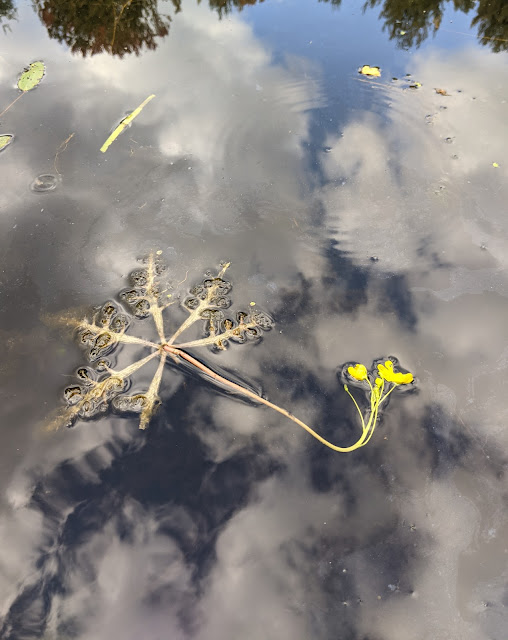
Alarm bells started tinkling, and then clanging, in my head. I took a series of photos without handling or disturbing the plant, then went home to peruse my aquatic plant books to help me sort through my suspicions ...
Everything I read filled me with dread, for it seemed I had found a plant not previously documented in Maine, and possibly invasive. On the other hand, I was thrilled that I had found something potentially exciting, a new discovery!
My mixed emotions about my find had me jostling about in bed for hours that night, as I pondered the implications - this plant's range is for the southeastern coastal areas of the United States, and now here it was in my Maine lake. I had stumbled upon it whilst searching for the notorious and insidiously invasive Najas minor, which I had newly discovered in our lake last year.
The Invasive Species Program Director for the Lake Stewards of Maine advised me to go back and retrieve the plant for sampling and positive identification. It seemed to be the swollen bladderwort, Utricularia inflata. The panel of "official" scientific verifiers have an established process to follow in order to reach an ID by consensus about a species heretofore not documented in Maine. Characteristics such as the length of the spokes, the shape of the floats (wedge shaped or parallel), the number of flowers on a raceme, the nature of the flower stalks (curved or upright), as well as the size, and coloration, of the flower needed to be assessed.
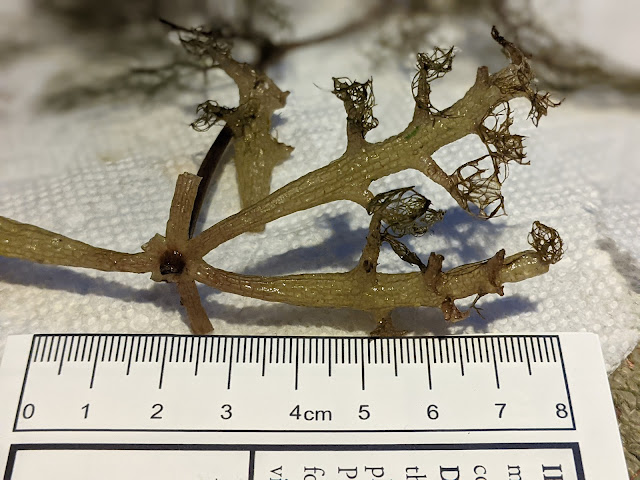 |
The air spaces in the spokes make a popping sound when they're pressed |
The sample I brought home the following day was already past its prime since it was so late in the season, but I managed to keep all the parts together in a basin of water as I paddled back. I jiggled all the algae, sediment and other debris off it, and washed it through many times before laying it out for drying and pressing. The more I looked at it, the more sure I became, even though I had never seen it before! I felt confident. It somehow seemed unnecessary to measure and deliberate over it - the more I looked at it, the more unmistakable it became.
I'm astonished at how much excitement and exuberance other botanists have shown about my find. There were phone calls, emails and texts back and forth from experts, and each wanted to be the first one to call Professor X, or Dr. Y, and let him, or her, know the news. Some shrieked with joy and excitement like a kid in a candy store! The enthusiasm generated was like being among bird watchers who wanted to "GRIP" a new species, a 'lifer,' the kind best described by Bill Oddie as 'a cosmic mindf@cker!' The authors of the "Aquatic and Wetland Plants of Northeastern North America" are hoping to include this new distribution information in their upcoming revised edition.
 |
Grinning like a Cheshire cat taking others to see my discovery |
I've learned a lot of new plants, all aquatic, since signing up for a Zoom course with the Lake Stewards of Maine in 2020. I've also learned how to do comprehensive kayak surveys and to bring a handful of new 'tools' with me. I've increased my arm strength and paddling stamina enormously without even realizing it - I don't blink an eye at the imagined destination and distance I have to cover - I just get up and get on the water every day, without giving it a second thought (at least there're no ticks out there). There have only been a few occasions when arthritis in my shoulder has been tweaked. The hand surgery has freed me enormously.
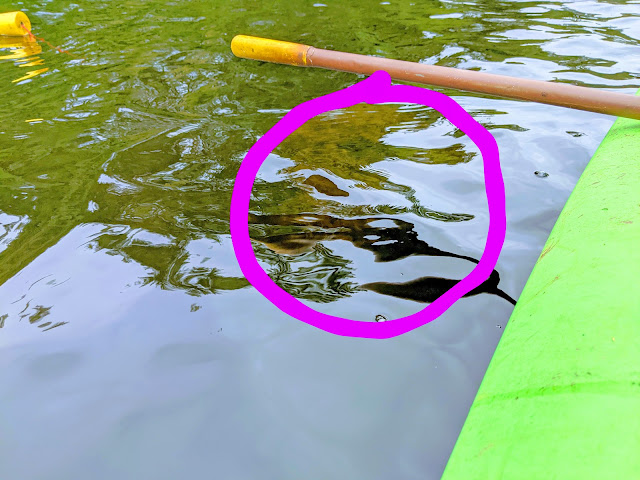
When I set off on an aquatic expedition, I have lots of things stowed in my kayak, not least of which are my phone in a watertight bag, and my flotation device. In addition I bring weighted markers, a net, sometimes a shrub rake, a bucket, a pair of scissors (with which I cut and free up branches of fishing line and hooks), and a viewing scope (an adapted pistol-case) to enable me to see down into the water. I tether it to my kayak and let it float along next to me while I peer down through its transparent bottom:

THIS is what I'm out there looking for - that very distinctive rusty colored canopy blooming just below the surface. It is very tiring on the eyes to survey so intently for hours on end, I must say, but it's actually exciting and worthwhile, in my mind, and I can't stop myself from doing it!
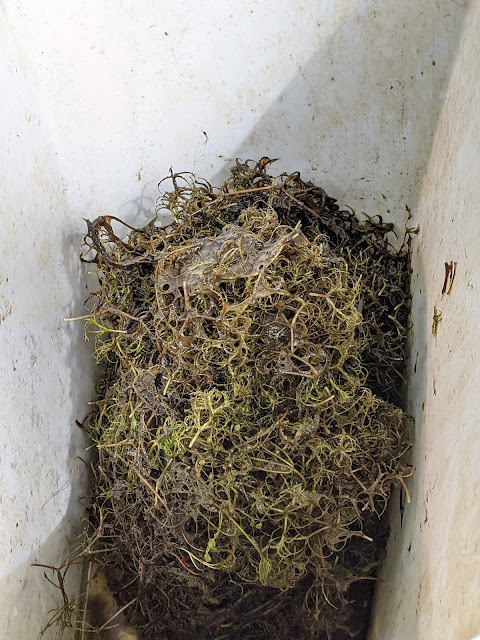
When I harvest a haul like this, I feel really good about hindering its efforts to disperse its seeds for the next year's growing cycle.