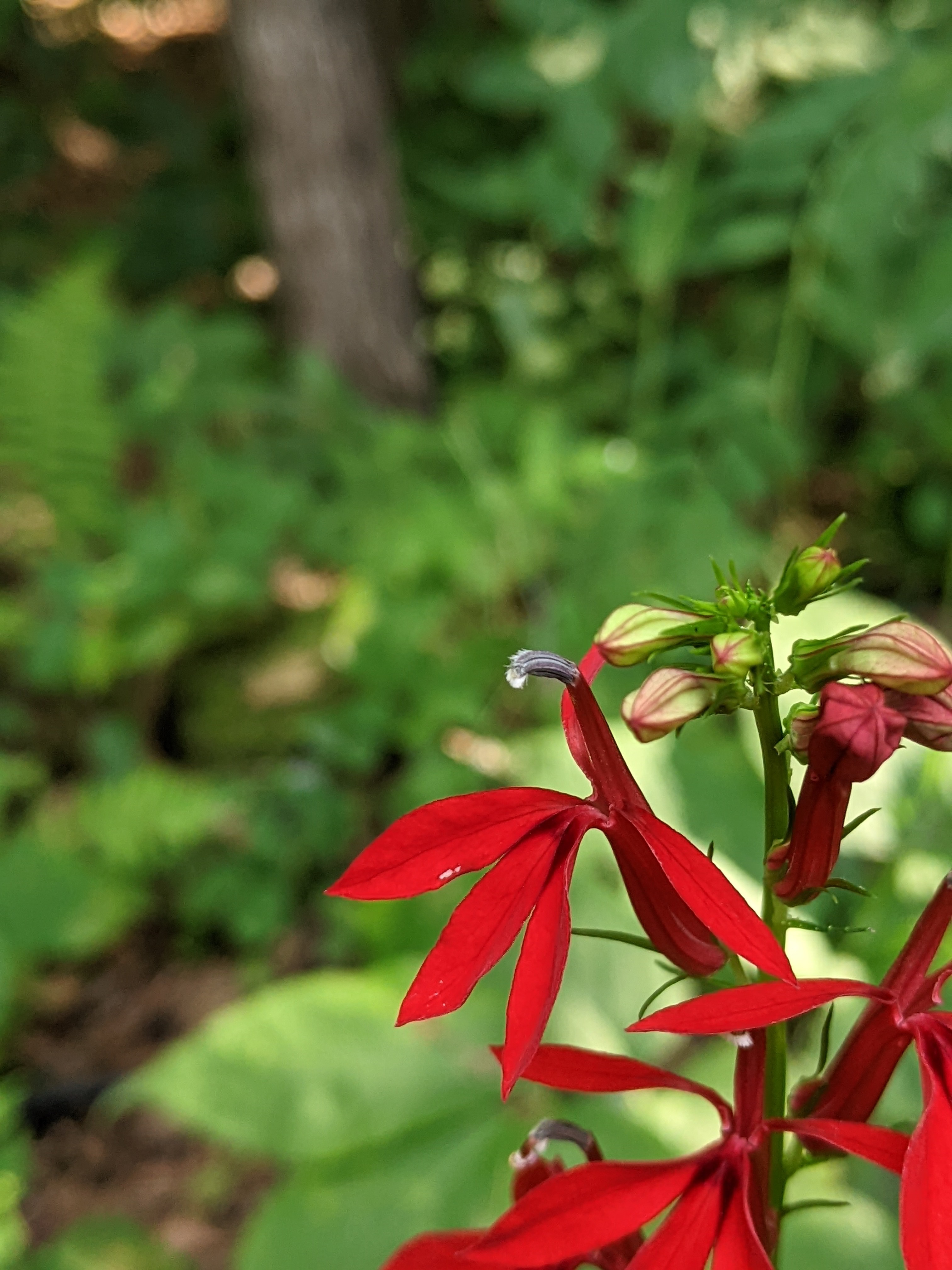
Lobelias, the cardinal flowers! What gorgeous displays they're giving me at this time of year. These are natives, beautiful and thriving.
I started off with one Lobelia siphilitica, and now it's everywhere. I weed them out of my lawn and place them where they won't get mown. An extract of the plant was once used by European settlers to treat syphilis, hence the scientific name -but my naughty thought is that it's because it spreads as easily!


My red cardinal flowers, Lobelia cardinalis, are doing splendidly this year too. Look at the deep red that glows in the sunlight, attracting hummingbirds to pollinate them.

They're hard to photograph, because there's so much going on with them - petals pointing this way and that, 2 up and 3 down, as well as reproductive parts that stick up at a different height: nothing's on the same plane. They look like a bunch of elegant birds swinging around a maypole!


 |
| The spent flower shows the female phase extending out beyond the moustache |